Homefront Press · Digital edition

Instant access after checkout
The 1955 Pantry: The One-Week Shelf Your Grandparents Kept, Rebuilt In Four Ordinary Shops
A 128-page book with a sources appendix, written in a calm voice. You add a little to each weekly shop, and when the Seven-Day Count reads seven, the shelf is complete.
60-day Full Shelf Guarantee. Every figure in the book has its public source listed in the appendix.
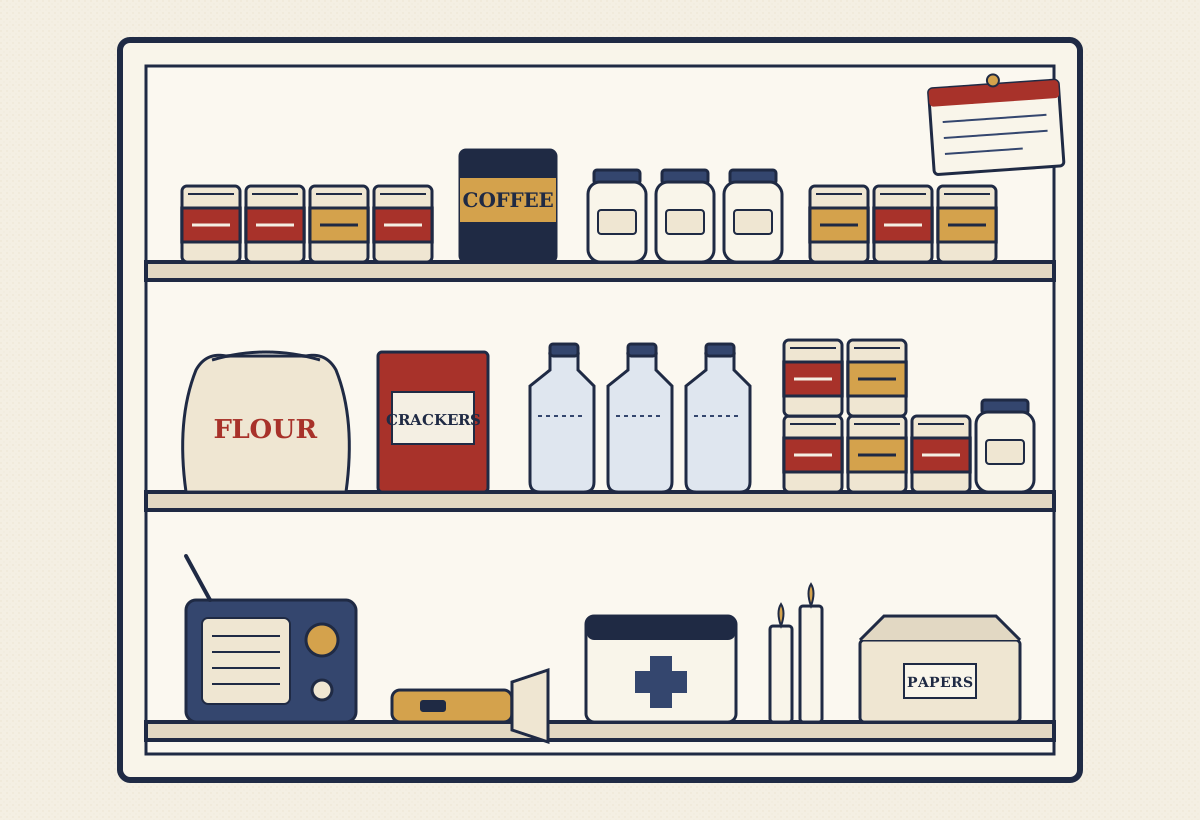
Go a Week Deep · Stock the Seven Shelves · Keep It Turning · The Unexpected Company Rule
You just read how a full week of food was ordinary housekeeping in 1955. This page shows you exactly what the book contains, so you can decide with the whole picture in front of you.
The book is called The 1955 Pantry. It is 128 pages across 15 chapters, with a sources appendix at the back.
If you are wondering whether this is another preparedness pitch, here is the short answer. There is no bunker in it, no year of rations and no worst-day picture. It is one shelf, seven jobs and a count you do with your own eyes.
What You Will Find Inside
- It walks the seven shelves one at a time, each with a single job, so you always know what goes where.
- It shows how the rotation keeps the oldest tin at the front, so nothing expires in the dark.
- It explains the Seven-Day Count: you walk the shelves, count what covers a week for the people in your home, and stop when it reads seven.
- It shows how to size the week to your household, whether that is one person or six.
Where The Price Comes In
The price and the terms sit further down this page, after the contents. You will see them once you have seen what the book holds.
The Program That Faded
The record is short, and all of it is still there.
In 1955 the Federal Civil Defense Administration urged every family to keep a seven-day supply of food and water at home. [1]
It ran an initiative to make the point and called it Grandma’s Pantry. Its line was plain: “Grandma was always ready for an emergency.” [1]
It printed a pamphlet with a question for a title: Grandma’s pantry was ready, is your pantry ready in event of emergency? A record of it sits in the University of North Texas library catalog today. [2] Its first lines said she was ready “when ten relatives arrived from Nebraska.” [7]
It produced 1,000 Grandma’s Pantry exhibits “for use in stores and at fairs, conventions, and other meetings.” Sears, Roebuck alone took 500 of them for its stores. [1]
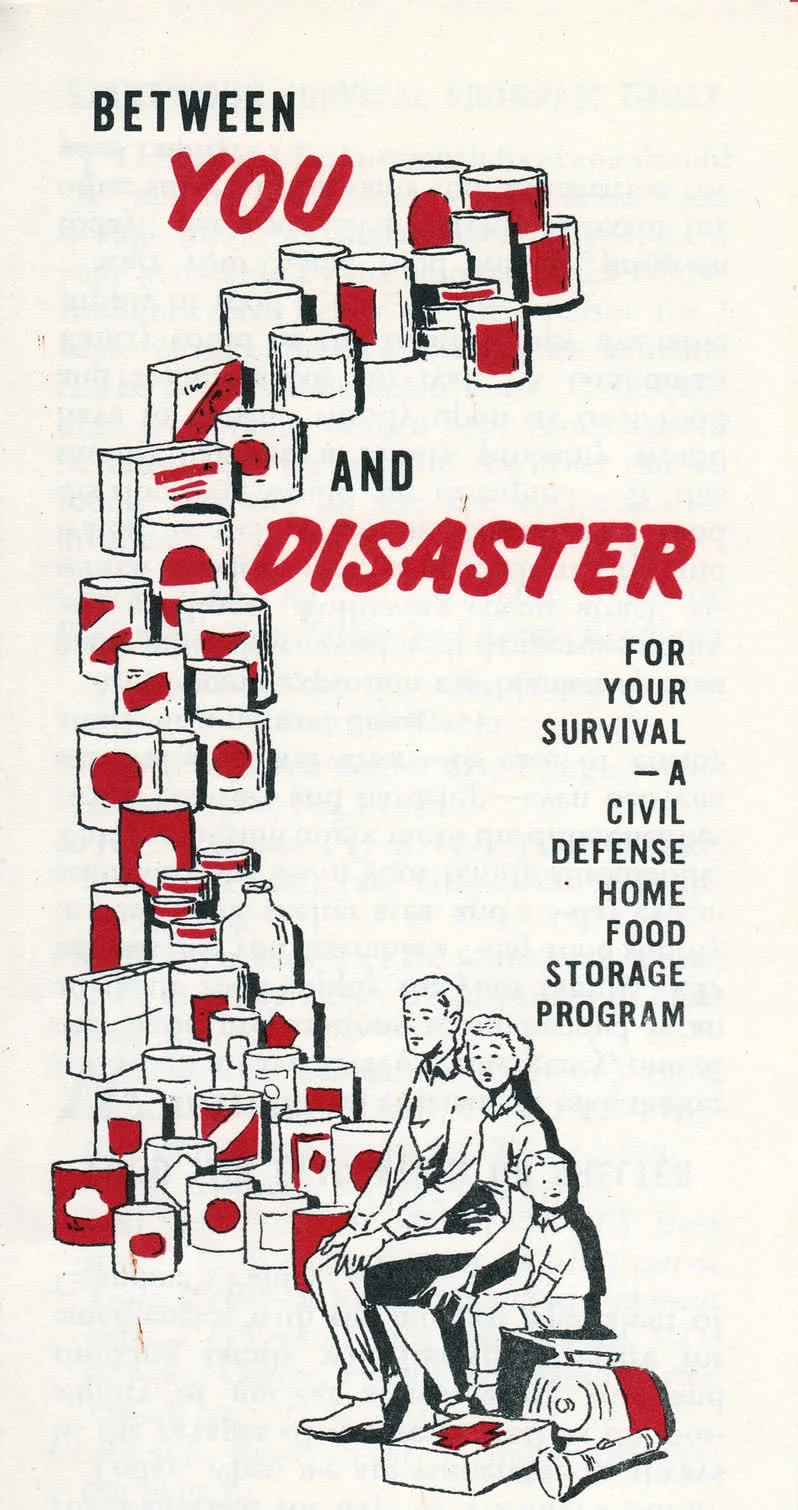
A year later the FCDA printed a home food storage leaflet, Between You and Disaster, and opened it under the same headline: “Grandma’s Pantry Was Ready.” [10]
The Maine Memory Network holds a Grandma’s Pantry Civil Defense card from about 1956, and a record of a Grandma’s Pantry display from about 1957. [3]
Then the program faded. In 1979 civil defense became one half of a new agency’s mission, FEMA’s. [4] Grandma’s Pantry did not make the move. Nobody hid it. It stopped being printed, and the idea went back into the kitchens it had come from.
Why A Government Put A Grandmother On A Pamphlet
In 1955 an emergency meant an atomic one. That was the reason for the program. [6]
What the planners did with that reason is the part worth knowing. They did not lead with the bomb. They led with Grandma.
They picked the most trusted figure in the American kitchen and pointed at what she already did. A week of food on ordinary shelves. Water put by. A kitchen that could feed the house through a bad week.
The threat they planned for never arrived. The pantry outlived it.
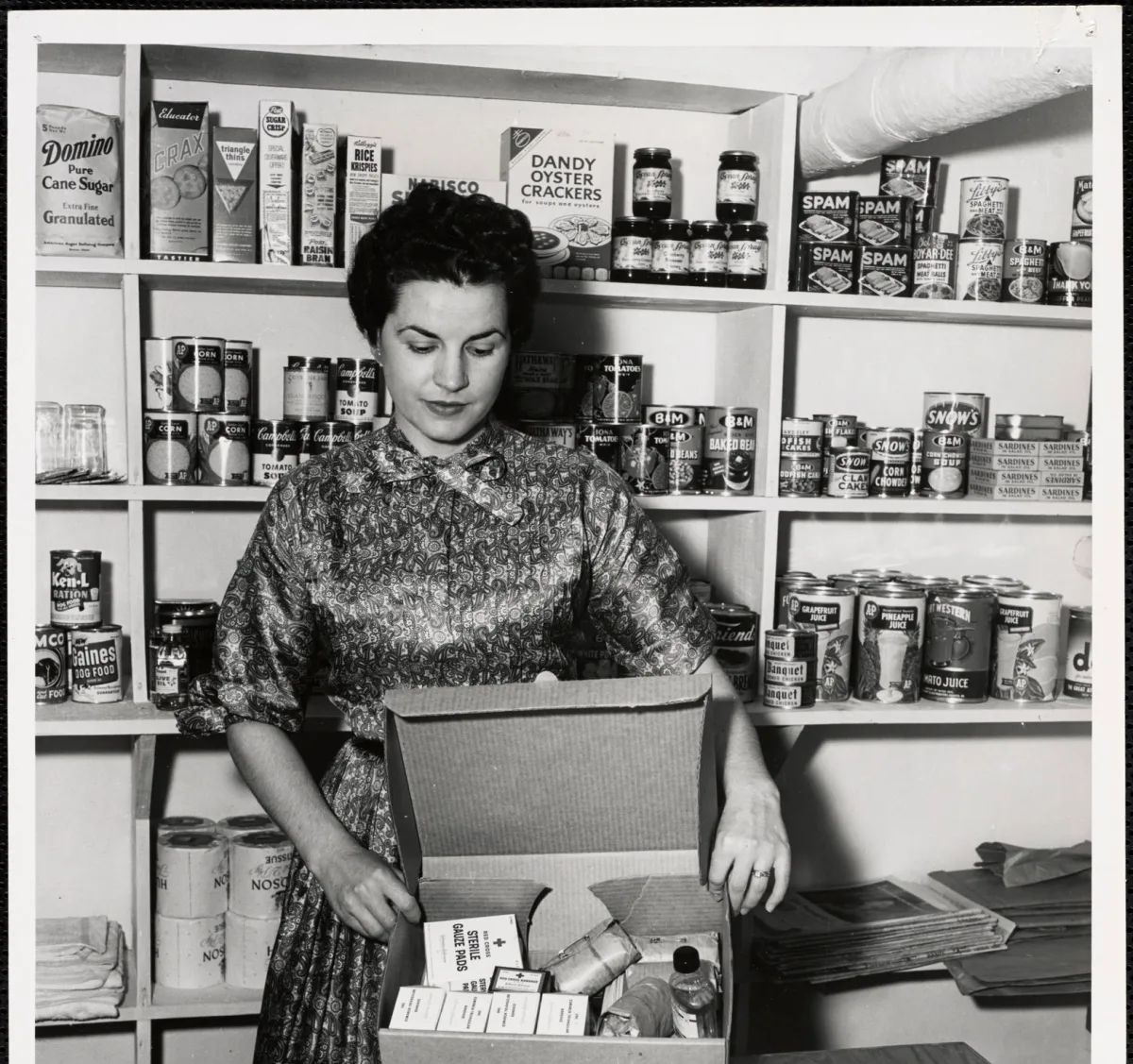
The weeks that catch a household short now are smaller and they come more often. The winter storm that closes the roads. The power cut on the whole street. The month the paycheck is late. The relatives who arrive a day early and stay two days longer.
A week on the shelf covers every one of them. So this book keeps Grandma’s pantry and leaves the reason for it in 1955.
Why The Stockpile Fails The Household That Buys It
When the news turns, the advice turns with it. Buy water by the case. Buy a bucket of freeze-dried meals. Buy the tins with the twenty-year label.
So a careful household does. It spends a lump sum in one afternoon. The pallet goes in the garage. The bucket goes under the stairs.
Then nothing happens, which is the good outcome, and the stockpile starts to fail anyway.
The water gets moved to make room for the bikes. The bucket stays sealed, because nobody in the house has ever eaten what is in it. The tins nobody likes sit behind the tins everybody likes. The dates come and go.
A year later the money is spent, the garage is full, and the kitchen shelves are exactly as deep as they were before the shopping trip.
That is an uneasy feeling: paying for safety and not being able to use it.
The stockpile is not foolish. A sealed bucket keeps, and for a long stretch far from any store it has a place. It is just the wrong tool for the job most households actually face, which is the ordinary bad week. The people who buy one are right to want to be ready. They were sold the wrong way to get there.
The stockpile
- Bought in one afternoon, after the news
- A lump sum, all at once
- Food nobody in the house has eaten
- Kept in the garage, out of sight
- Checked once, then forgotten
- Expires quietly
- Has to be bought again
Grandma’s pantry
- Built over four normal shops
- About $12 to $16 per person added to each weekly shop
- The food the house already eats
- Kept on the kitchen shelves, in plain sight
- Eaten and replaced every week
- Never expires, because it never sits
- Refills itself on the normal shop
Get The 1955 Pantry
The book, the FCDA’s 1956 leaflet restored, and three printable tools. $37, one payment.
Start My Pantry TodayInstant access after checkout The Full Shelf Guarantee: 60 days, one email, every dollar back.
The Unexpected Company Rule
Grandma never stockpiled. She did something quieter, and it worked better.
Her everyday shelves ran a week deep, and she refilled them on her normal shop.
That is the rule, and it has three parts:
- Keep a week of the food the household already eats.
- Refill it on the shop the household already makes.
- Eat the oldest first.
Because the reserve is ordinary food, it never sits. It gets eaten and replaced, so it never expires. Because it is built on the normal shop, it costs nothing extra once it is in place. And because it is spread across the shelves the house already has, nobody sees it.
The name comes from the FCDA’s own 1956 leaflet, Between You and Disaster. Under the headline “Grandma’s Pantry Was Ready”, it remembered her shelves as “ready for any emergency, whether it be unexpected company or roads blocked for days by a winter’s storm.” [10] A kitchen kept this way can feed whoever turns up. The neighbors when the street loses power. The grandchildren who stay an extra night. A household of four through a week of snow.
Here Is The Whole Method, Before Any Price
This page is selling a $37 book, and there is no point pretending otherwise. So here is the method itself, free, before anything else is asked of you.
Step 1
Go a Week Deep
The 1955 standard, sized to your household. A week means seven days of meals and water for everyone who lives in the house. Today’s official figure for water is one gallon per person per day, so a week for two people is fourteen gallons. The book shows where some of it is already sitting before a single bottle is bought.
Step 2
Stock the Seven Shelves
Water, keeping foods, the company shelf, light and heat, the medicine cabinet, radio and records, clean and sanitary. Seven shelves, because a week of food is not a week of readiness. A house with forty tins and no manual can opener has a problem on the first night.
Step 3
Keep It Turning
The Ever-Full Rotation: eat from the front, refill at the back. The FCDA’s 1956 leaflet asked for the same: “Check ‘PANTRY’ at Least Once a Month, Preferably More Often, and Rotate Regularly.” [10] That one habit is the whole difference between a pantry and a stockpile.
You could start tonight with nothing more than this paragraph. The book turns each step into a shopping list, a shelf and a habit, one short chapter at a time, so the starting is easy and the keeping is automatic.
What it costs at the till. A careful reader asks this first, and should: is this a $37 book that sends a household out to spend a great deal more? Here is the arithmetic. The four-shop pace adds about $12 to $16 per person to each weekly shop at planning prices. [9] For a couple that is about $27 a shop, a little over $100 across the four. For a family of four it is about $50 a shop, about $200 across the four. The water is filled at home from the tap. What that money buys is one week of the food the house already eats, bought ahead. After the fourth shop the weekly bill goes back to what it was, because the week on the shelf is eaten from the front and replaced at the back. A household that adds less still gets there. It takes more shops, and none of them is a lump sum.
The Seven Shelves Of A House That Is Never Caught Short
- Water. The water already stored in your home before you buy a single bottle (the house already holds some, in places nobody thinks to count)… And the simple way to keep a stored week fresh, so it is there on the day it is needed.Chapter 5, The Water Already Hidden in Your Home
- Keeping foods. The staples that outlast the emergency they were bought for (and the ones that only look as if they will)… So the shelf holds food the house will actually cook.Chapter 6, The Staples That Outlast the Emergency
- The company shelf. The one shelf that turns a prepared house into the house everyone comes to (a small amount on top of the week, kept for whoever arrives)… So when the whole street is dark, the neighbors know which door to knock on.Chapter 7, The Shelf That Makes You the House Everyone Comes To
- Light and heat. How to keep the house warm and lit when the grid goes down (with the order to do it in)… And the first-night plan that comes free with the book.Chapter 8, A Home That Stays Warm and Lit When the Grid Goes Down
- The medicine cabinet. The short list of first aid basics a household actually reaches for at 2 a.m. (seven days of every prescription, and the everyday first aid basics)… And how to store them so every item is in date when it is needed.Chapter 9, Never Caught at 2 a.m. Without the Basics
- Radio and records. What to keep for news and money when the screens go dark (cash, the papers that matter, and a radio that needs no outlet)… So the household knows what is happening and can still pay for what it needs.Chapter 10, Information and Money When the Screens Go Dark
- Clean and sanitary. The problem nobody plans for, handled with one shelf of ordinary supplies… So a long week stays a clean one.Chapter 11, The Problem Nobody Plans For
All Seven Shelves, In One Book
$37, one payment. Instant access after checkout.
Get The 1955 Pantry NowInstant access after checkoutThe Full Shelf Guarantee: 60 days, one email, every dollar back.
What Else Is Inside The 1955 Pantry
The book starts with the shift and the two-minute count, because those are what get the first shelf filled. The seven shelves come after. The habit that keeps them full comes last.
- Why Grandma never bought a stockpile (and what she bought instead, every week, without thinking about it)… The idea that makes every chapter after it easy.Chapter 1, Why Grandma Never Bought a Stockpile
- How many days your kitchen could feed the household today (it takes two minutes to count)… And why that one number, written on the Pantry Card, is the only one you need to beat.Chapter 2, Your Seven-Day Number
- What a week actually holds by the 1955 standard (it is not a closet full of cans)… So you know exactly when you are done.Chapter 3, The 1955 Standard: What a Week Actually Holds
- How to go a week deep without a big shop (four normal trips, about $12 to $16 per person added to each)… So the reserve is built on the shop the house already makes, with no lump sum.Chapter 4, How to Go a Week Deep Without a Big Shop
- The Ever-Full Rotation: eat from the front, refill at the back (new things go at the back, the house eats from the front)… The one habit that means a pantry never expires.Chapter 12, The Ever-Full Rotation
- Dinner from the back of the cupboard (the oldest cans become this week’s dinners)… So the rotation happens at the dinner table instead of on a chore list.Chapter 13, Dinner From the Back of the Cupboard
- The Pantry Year: the seasons, the storms and the twice-a-year check (one twenty-minute check in spring, one in fall)… So the shelves are ready before the weather is.Chapter 14, The Pantry Year
The Fifteen Chapters, And The Sources
Four Things That Come With The Book
The book tells the house what to do. These four make it easy to start tonight and easy to keep.
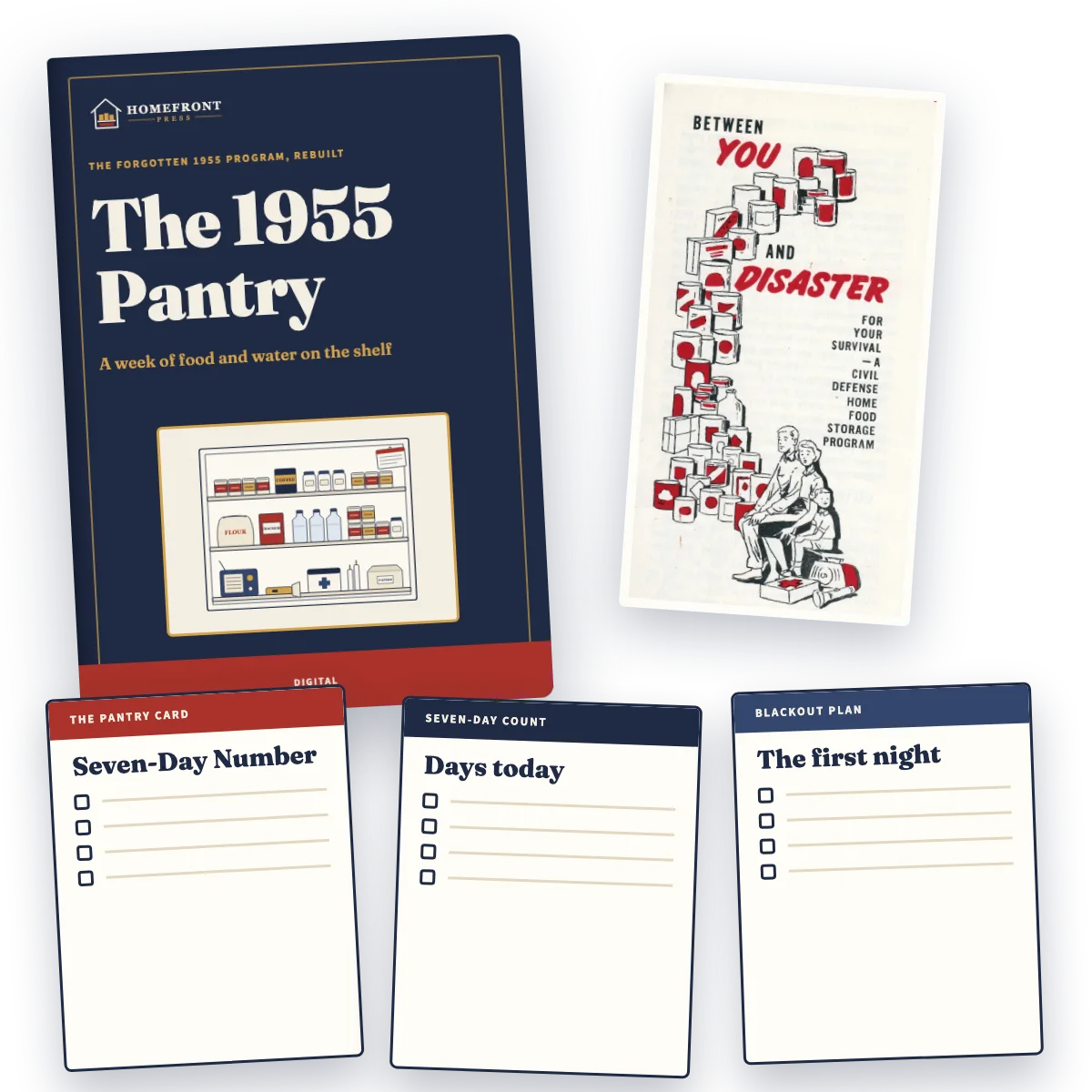
“Grandma’s Pantry Was Ready”: the FCDA’s own 1956 leaflet
The program’s home food storage leaflet, restored, so you can read the standard in the words the FCDA printed in 1956, from its seven-day food list to “rotate regularly”. It sits in your member area beside this year’s official checklist from Ready.gov, so you can see what changed in seventy years and what did not.
The Pantry Card
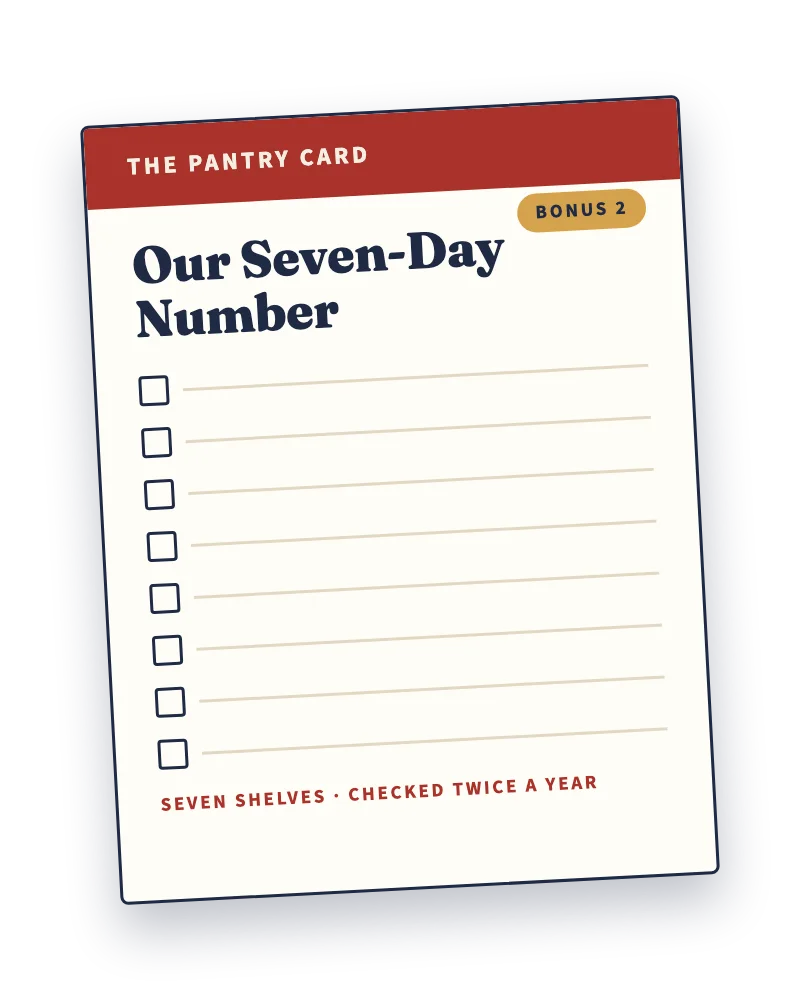
A printable family card and inventory, modelled on the Civil Defense card a Maine museum keeps from about 1956. It holds the household’s Seven-Day Number and what lives on each shelf. It goes on the inside of a cupboard door.
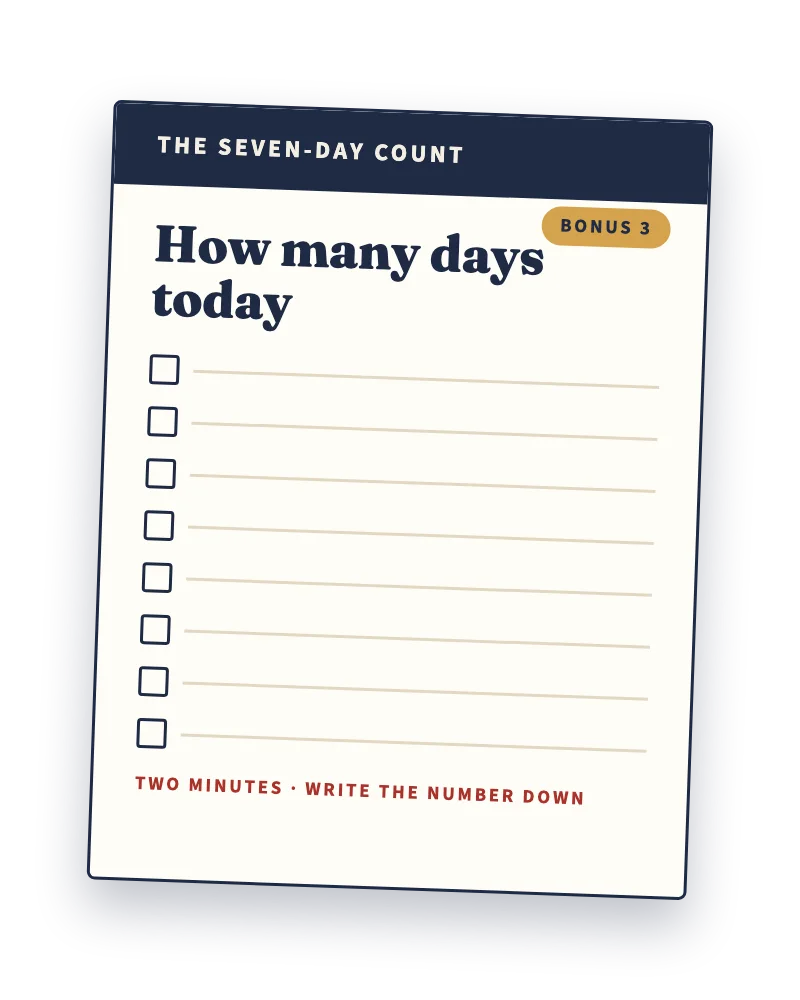
The Seven-Day Count
A two-minute worksheet. Count how many days the kitchen could feed the household today, and write the number on the Pantry Card. That number is the one you beat.
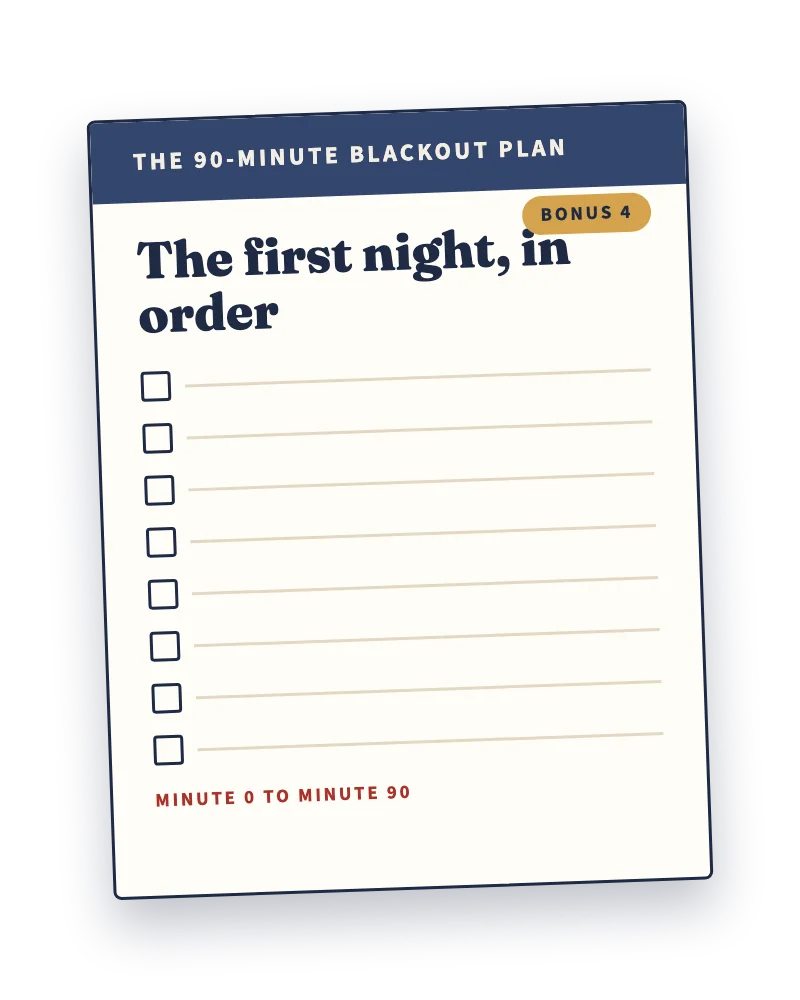
The 90-Minute Blackout Plan
The first night of a power cut, planned in order. What to do in the first ninety minutes, so the evening stays calm and the freezer stays shut.
Why It Costs $37
The whole method is to spend nothing extra on food. A book that cost like a stockpile would argue against itself. So it is $37, once, and the 1956 leaflet and the three tools come with it.
 Download The 1955 Pantry For $37Instant access after checkout
The Full Shelf Guarantee: 60 days, one email, every dollar back.
Who This Book Is Not For
A book on a nightstand puts nothing on a shelf. So before the price, here is who should not buy it.
- Anyone looking for a bunker plan, a year of freeze-dried food or a reason to be afraid. Other books sell that. This one sells a calmer kitchen.
- A household that will not change one thing about its next shop. The method is small. It is still a habit, and a habit only works when it gets used.
- Anyone who wants medical advice. The medicine cabinet chapter covers first aid supplies and how to store them. For anything else, the doctor and the pharmacist come first.
- Anyone expecting a government publication. Homefront Press is an independent publisher. It is not affiliated with FEMA, Ready.gov or any government agency. The 1955 material is reproduced for its history.
It is for the household that wants to be the one that is never caught short, and the house the family comes to when the lights go out.
The Full Shelf Guarantee
$37 is a small amount, and it still counts. So the risk sits with us.
Read the book. Do the Seven-Day Count. Make your first shop.
If The 1955 Pantry has not shown you how to put a week on your shelves, send one email to support@the1955pantry.com within 60 days and we refund every dollar. No forms. No questions.
Keep the leaflet and the three tools as our thanks for trying.
Every Fact On This Page Can Be Checked
- [1] The seven-day supply, the Grandma’s Pantry promotion, the slogan, the 1,000 exhibits and Sears’ 500: Federal Civil Defense Administration, Annual Report for 1955, pp. 8 and 82 (Internet Archive).
- [2] The 1955 pamphlet: University of North Texas library catalog, record 731-19320.
- [3] The Civil Defense card, about 1956, and the display, about 1957: Maine Memory Network, items 29118 and 28915.
- [4] FEMA and civil defense, 1979: fema.gov, “History of FEMA”.
- [5] One gallon of water per person per day, and “several days” of supplies: Ready.gov, “Build a Kit”.
- [6] The atomic purpose: History.com, “At Cold War Nuclear Fallout Shelters, These Foods Were Stocked for Survival”, Sarah Pruitt, updated 2025.
- [7] The 1955 pamphlet’s opening line: Jean Wood Fuller, the FCDA’s director of women’s activities, reading it aloud in a 1976 oral history, Regional Oral History Office, Bancroft Library, pp. 187 to 188.
- [8] The same phrase on the radio: “Take the Step: Grandma’s Pantry”, a civil defense radio spot of the 1950s, transcript at the Authentic History Center.
- [9] Planning prices behind the four-shop pace: Bureau of Labor Statistics average retail food prices (September 2026), USDA Economic Research Service (2023), and store-brand online prices read on 6 November 2026. Your store will differ.
- [10] Federal Civil Defense Administration, leaflet L-1, Between You and Disaster (1956), panels 2 and 3. Scan at the Internet Archive.
The appendix of the book lists every source chapter by chapter.
Questions, Answered
What exactly do I get?
The 1955 Pantry as a digital book, fifteen chapters and a sources appendix, in your member area on any phone, tablet or computer. Plus “Grandma’s Pantry Was Ready”, the FCDA’s own 1956 leaflet, restored, the Pantry Card, the Seven-Day Count and the 90-Minute Blackout Plan. Everything is digital and everything is there the moment checkout finishes.
What do I actually do with this, week to week?
Very little that is new. On the shop you already make, you add a set amount of keeping food until the shelf is a week deep. New things go at the back. The house eats from the front. Twice a year you check the shelves against the Pantry Card. That is the whole routine.
Do I have to spend a lot on food?
Not in one go. The four-shop pace adds about $12 to $16 per person to each weekly shop at planning prices: about $27 a shop for a couple, about $50 for a family of four. A household that adds less gets there too, over more shops. It is all food the house already eats, and there is no lump-sum shop anywhere in the book.
Does it work for my household?
The Seven-Day Count sizes the week to the people who live in the house, one person or seven. The method works on whatever shelves the house has, a walk-in pantry or one cupboard. Water takes the most room, so Chapter 5 deals with it first.
Is this about the Cold War?
One paragraph of history explains why the program existed in 1955. The rest of the book is about the ordinary weeks that catch a household short now: storms, power cuts, a late paycheck, a full house.
Is this a government program?
No. Homefront Press is an independent publisher, not affiliated with any government agency. The book follows today’s official guidance at Ready.gov and goes further on one point: it plans for a week, the 1955 standard.
Can I print it?
Yes. The 1955 Pantry is a digital book, and every chapter and all four tools print at home on ordinary paper.
Do you offer more help?
Yes. The Four-Week Pantry Build turns the method into four ready-made shopping lists for your household size and your pace. It is offered after checkout. The book works without it.
Is there a guarantee?
The Full Shelf Guarantee. 60 days, one email, every dollar back, and you keep the tools.
A Week Was The Standard
It comes down to a book, a habit Grandma kept without ever writing it down, and one fact worth holding onto.
Seventy-one years after the Grandma’s Pantry pamphlet, today’s official checklist asks a household to keep supplies for “several days.” [5] The 1955 standard was a week. Grandma’s pantry was a week.
Tonight, before deciding anything, count it. Open the cupboards and work out how many days the kitchen could feed everyone who lives in the house.
If the number is under seven, that number is the reason to start.
The 1955 Pantry, digital edition
$37
One payment
Yes, I Want My Pantry A Week DeepInstant access after checkout🔒 Secure checkout
The Full Shelf Guarantee: 60 days, one email, every dollar back.
P.S. The book costs $37 and The Full Shelf Guarantee runs for 60 days. If the first chapter does not change how you look at your own shelves, one email brings the $37 back.